Arrivederci : Chet in Italy
In 1959, Chet Baker, “Prince of Cool” and up-and-coming big name in 50s jazz ,whose talents prompted Charlie Parker to tell Dizzy Gillespie and Miles Davis that there was “a little white cat out in California who [was] going to eat [them] up” and who was voted world’s best jazz trumpeter in several press publications, got out of a four-month stint at Riker’s Island for marijuana possession and promptly shipped off to Italy.
Chet’s recreation of choice was nothing quite as innocent as smoking grass – he was a heroin addict, a habit that had started by most accounts in the early 50s, and not a particularly nice guy. It’s somewhat difficult to conciliate his behaviour in his personal life with the gentleness and fragility of his singing performances or the melodic poetry of his trumpet-playing, but the guy was a real piece of work. At the time (and perhaps still today, to a certain extent), this tended to add to an artist’s mystique which probably won him some sympathy points with his audience when he was repeatedly arrested, but in hindsight the balance is harder to find. Addiction was rampant in the jazz community and many of its members died young, but unlike some of his contemporaries like Bill Evans who always managed to put his music first, Baker pawned his instruments for drug money and made composers work with him through prison bars.
This may come across as a rather brutal and unsympathetic portrait, but I adore Chet’s work, from the beginning to the end of his career. Chet Baker Sings was for me, as for many other people, an easy and appealing entry into jazz, featuring both upbeat renditions of standards and more mellow, emotional interpretations (the album has his studio performance of My Funny Valentine, arguably one of his most famous covers, but his version of I Get Along Without You Very Well and The Thrill Is Gone are equally heartfelt). The air and frailty of his voice was criticised, and still is, for being technically lesser than many of his contemporary jazz singers with stronger voices, larger ranges and deeper timbres, but these faults were what lent so much emotion to his music.
Chet Baker Sings : It Could Happen To You presented more light-hearted choices of standards that worked a little less to his strengths but I love them all nonetheless, especially the swinging Old Devil Moon, by far my favourite interpretation of the song. Plus, it’s on this album that he started to record scat solos, which he constructs almost exactly like his trumpet ones. Outside of his singing, all of his live albums are worth listening to just for those, and his sometimes sombre, always cool-headed approach to playing.
Just before being arrested in 1959, he was busy in the studio recording Chet, which, outside of being, for many, his best work, has an all-star cast of fellow big names, including Miles Davis’ rhythm section, Philly Joe Jones, Paul Chambers and Bill Evans (Herbie Mann, phenomenal flutist, was also present). No singing on this one, the focus was fully on the playing. There’s a version on there of You And The Night And The Music which sounds so heavy and sombre in its theme exposition that it’s suffocating. Also on there is You’d Be So Nice To Come Home To which he would both play and sing again during one of his last recorded live performances in Tokyo in 1987. That whole concert is almost painful in its delicacy, as he sings with a voice more fragile than ever, broken by many years of drug abuse and other personal tragedies (amongst other things the guy fell out of a window and had his teeth kicked in so badly that he had to relearn how to play the trumpet from scratch – not much fun). If there’s one version of My Funny Valentine to defeat them all, it’s the one he sang that night.
The goal of this introduction is not to draw any kind of overview of Chet Baker’s oeuvre. Like most guys playing back then, often for financial reasons, he never stopped recording. He left behind an absolutely massive body of work, and I make no claim to have heard, nor even to like, all of it. He worked an absolute ton before moving himself to Italy for a few years and he continued to record up until his death in 1988. The point, instead, is to give an idea of how important his output has been to myself and many others, to underline just how frustrating it is to go looking for Italian newspaper clippings and old articles mentioning him, hoping to get an idea of how his arrival there was received, and find only headlines about him getting busted again.
It’s presumed that Baker left for Europe in order to get away from the scrutiny of the American press and public, not to mention its legal system (by then, he had eight narcotics charges under his belt). Unfortunately, a change of scene without a change of behaviour led to no better results in Italy, where almost every headline featuring his name in 1959 newspapers mentions his heroin habit and sometimes even his infidelities.
Umberto Bindi's Arrivederci
Arrivederci
Take my hand and smile without crying
Arrivederci
For one last time, it’s nice to pretend
We challenged love as though it were a game
And now let’s pretend we’re only parting for a little while
Arrivederci
I’m stepping out of your life, let’s say our farewells,
Arrivederci
This will be our goodbyes, but let’s not dwell on it
With a handshake, as good, sincere friends
We smile at each other to say:
“Arrivederci”
Chet Baker's Arrivederci
Arrivederci
Wipe off that tear as I whisper, 'til we meet again
Arrivederci
Though it's goodbye forever, let's pretend
We dared love to catch us and always laughed at romancing
Now we must realise we're losers in this crazy gambling
Arrivederci
We knew it was not forever from the very start
Arrivederci
Our sunny days are over, now's the time to part
Kiss me again, for the last time
Darling, forgive me, forget me,
I'm stepping out from your life,
Arrivederci
Kim Gannon (lyricist of I’ll Be Home For Christmas and many other standards and songs for 1940s cinema) apparently wrote the translated lyrics for Baker’s version, and though they’re very close, sometimes almost identical in wording, Bindi’s version suggests the amicable separation of two people who still care for each other and have made a mutual decision of sorts, whereas the goodbyes, in Baker’s, seems rather unilateral.
Bindi didn’t write his own lyrics – Arrivederci’s were written by Giorgio Calabrese, an Italian songwriter who did a few translations of his own, worked frequently with Charles Aznavour, and notably wrote the lyrics for Piano, which was retitled Softly, As I Leave You in English and recorded by Matt Munro and Frank Sinatra, both to great success, as well as being performed by Elvis ! (incidentally, this song’s meaning was also slightly altered when translated, going from a tale of being left quietly in the night to a tale of leaving, possibly because it was originally performed by a woman, singer and actress Mina, and attitudes towards a woman doing the leaving were not too hot).
As such, drawing parallels between Bindi’s personal history and the lyrics isn’t necessarily very relevant, but I still find it interesting to mention that Bindi was gay, and it practically cost him his career. In the very late fifties, he was an up-and-coming singer and composer who had already penned some hits and was well on his way to commercial and critical success, but in 1961, at Sanremo festival, he performed with a ring on his pinky, a code for homosexuality, and from then on was practically ousted from television, radio and music festivals alike. Although he never stopped writing and continued to perform here and there, it took a very long time for him to get back on his feet in public eye, and the article shown below, from the 13/10/1977 edition of newspaper La Stampa, suggests by that year he was only just beginning to recover.
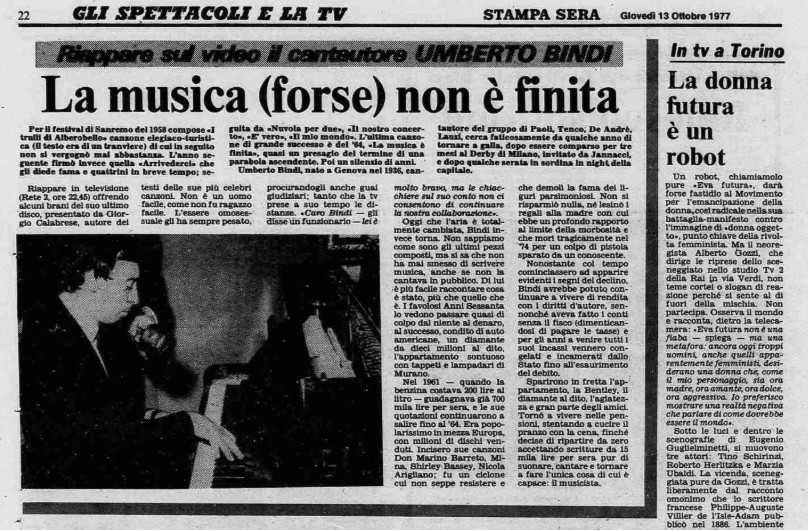
In such a political climate and with such dire consequences being brought on by his sexuality, the themes of his Arrivederci make a lot of sense : a peaceful, loving separation between two lovers-turned-friends may be preferable to the backlash society would inflict upon them.